Brayton Cycle
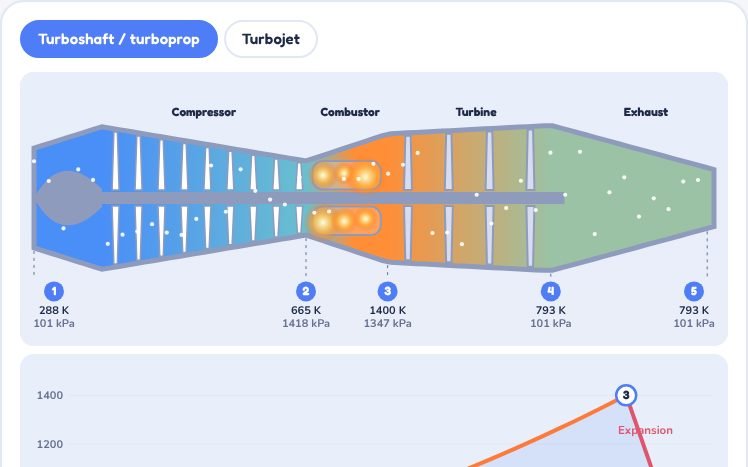
Compress, burn, expand: see the gas turbine cycle on a temperature-entropy diagram and along the engine
Technical GeneralAerodynamics & enginesLifetime
Brayton cycle
Brayton Cycle is part of lifetime access
Log in if you already have lifetime access, or unlock all 39 simulators, the full question bank and every flashcard for ₹3,499.
Or try the free ones: Wind Triangle and Altimeter.
Your account is on the free plan. Unlock all 39 simulators, the full question bank and every flashcard for ₹3,499, once.
More Technical General simulators
Engine CyclesLifetimeAttitude & TurnLifetimeGPWS / TAWSLifetimeTCASLifetimeWhat to try
- Raise the pressure ratio and watch the cycle shape and the efficiency change.
- Raise the turbine entry temperature and see the net work grow.
- Turn on the ideal cycle to see how much the compressor and turbine losses cost.
- Switch to the turbojet to see why the nozzle makes the thrust.
Exam point
Brayton: constant-pressure heat addition. Efficiency depends only on the pressure ratio for the ideal cycle: 1 - 1/r^((g-1)/g). Net work depends mainly on the turbine entry temperature.
Study aid only. Figures here are simplified and fictional, so always use current DGCA and ICAO documents and the approved manual for real operations.