PNR & Equal-Time Point
How far you can go and still come back, and where continuing and returning take the same time
NavigationFlight planningLifetime
Result
PNR & Equal-Time Point is part of lifetime access
Log in if you already have lifetime access, or unlock all 39 simulators, the full question bank and every flashcard for ₹3,499.
Or try the free ones: Wind Triangle and Altimeter.
Your account is on the free plan. Unlock all 39 simulators, the full question bank and every flashcard for ₹3,499, once.
Practise the questions
Critical Point & PNR106 questionsRevise with flashcards
Critical Point & PNR7 cardsMore Navigation simulators
Weight & BalanceLifetimeWind TriangleFreeCrosswind ComponentLifetimeGreat Circle & Rhumb LineLifetimeWhat to try
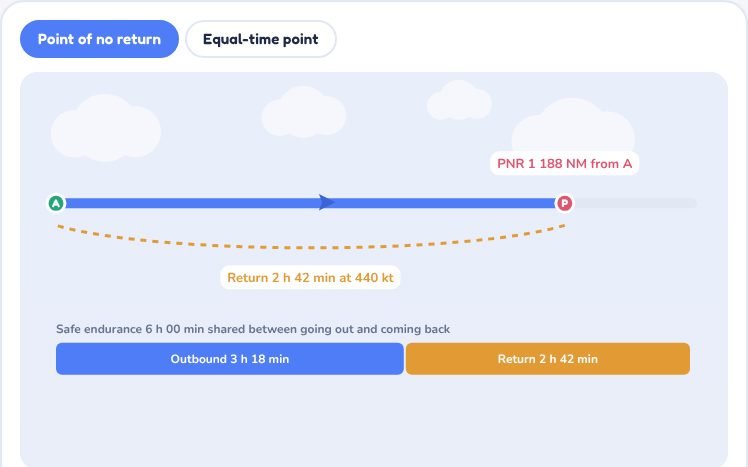
- Set the airspeed, the wind and the endurance and watch the point of no return slide along the route.
- Try a headwind, then a tailwind of the same size, and compare the distances.
- Switch to the equal-time point and see why a headwind towards the destination pushes it further out.
Exam point
PNR and ETP use the same equation: distance = D (or endurance x GS out) x GS home / (GS out + GS home). Always use groundspeeds, never true airspeed, once there is wind.
Study aid only. Figures here are simplified and fictional, so always use current DGCA and ICAO documents and the approved manual for real operations.