Great Circle & Rhumb Line
Compare the two routes between any two places: distance, track angles, convergence and conversion angle
Result
Great Circle & Rhumb Line is part of lifetime access
Log in if you already have lifetime access, or unlock all 39 simulators, the full question bank and every flashcard for ₹3,499.
Or try the free ones: Wind Triangle and Altimeter.
Your account is on the free plan. Unlock all 39 simulators, the full question bank and every flashcard for ₹3,499, once.
More Navigation simulators
Time Zones & SunriseLifetimeWind TriangleFreeCrosswind ComponentLifetimePNR & Equal-Time PointLifetimeWhat to try
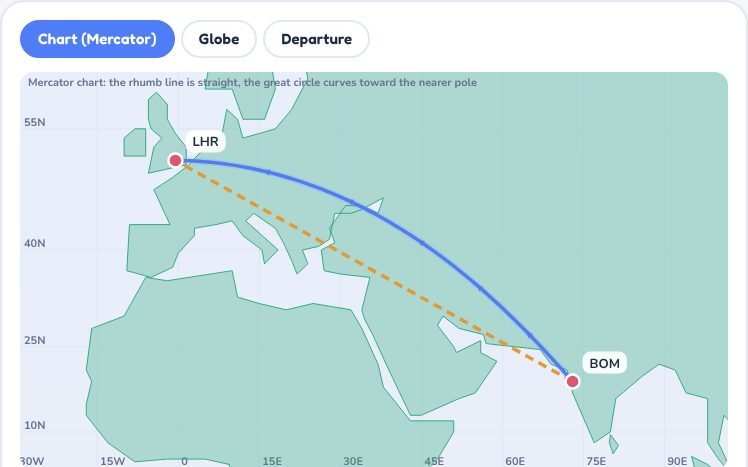
- Pick Mumbai to London, then switch between the chart and the globe to see why the great circle is the shortest route.
- Press Fly both routes to watch the two aircraft. The rhumb-line aircraft arrives later.
- Use Custom and the sliders to put both places on the equator or on one meridian, and see the two routes match.
- Open the Departure tab and see why one degree of longitude gets shorter toward the pole.
Exam point
Convergence = change of longitude x sin(mean latitude). Conversion angle = half the convergence. In the northern hemisphere the great circle lies on the pole side of the rhumb line, and a rhumb line is a straight line on a Mercator chart.
Study aid only. Figures here are simplified and fictional, so always use current DGCA and ICAO documents and the approved manual for real operations.