Airspeeds & Mach
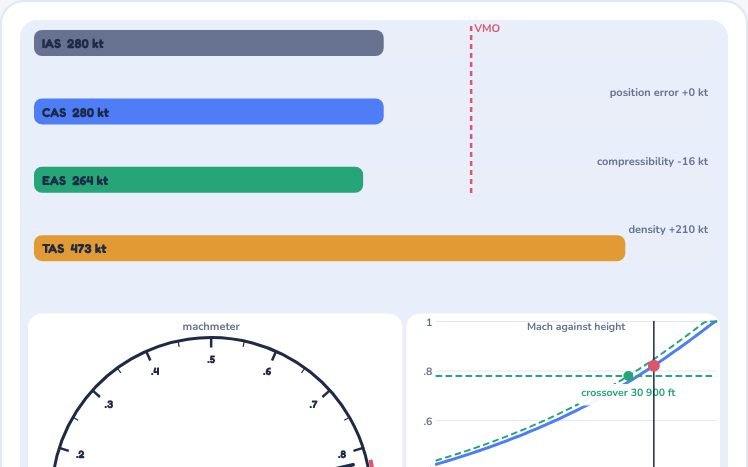
See how IAS, CAS, EAS, TAS and Mach number relate at any height and temperature, and where the climb crossover is
Airspeeds & Mach is part of lifetime access
Log in if you already have lifetime access, or unlock all 53 simulators, the full question bank and every flashcard for ₹3,499.
Or try the free ones: Wind Triangle and Altimeter.
Your account is on the free plan. Unlock all 53 simulators, the full question bank and every flashcard for ₹3,499, once.
More Technical General simulators
Pitot-Static FailuresLifetimeAttitude & TurnLifetimeEngine CyclesLifetimeBrayton CycleLifetimeWhat to try
- Move the altitude slider with a fixed IAS and watch TAS and Mach grow while CAS stays the same.
- Switch to I know the Mach number to see how CAS falls as you climb at a constant Mach.
- Raise the temperature above standard and see the speed of sound, the TAS and the Mach number change.
- Change the climb schedule numbers and see the crossover altitude move on the chart.
Exam point
The chain is IAS, then CAS (remove instrument and position error), then EAS (remove compressibility), then TAS (correct for density). Mach number is TAS divided by the local speed of sound, which depends only on temperature.
Study aid only. Figures here are simplified and fictional, so always use current DGCA and ICAO documents and the approved manual for real operations.