Wake Turbulence & Separation
Learn the wake turbulence categories, the minimum separation behind each, and how vortices sink, spread and drift
Aircraft in front (leader)
Aircraft behind (follower)
Situation
Drag the small yellow aircraft to test where you would be hit.
Wake Turbulence & Separation is part of lifetime access
Log in if you already have lifetime access, or unlock all 53 simulators, the full question bank and every flashcard for ₹3,499.
Or try the free ones: Wind Triangle and Altimeter.
Your account is on the free plan. Unlock all 53 simulators, the full question bank and every flashcard for ₹3,499, once.
Practise the questions
Air Traffic Services181 questionsRevise with flashcards
Air Traffic Services19 cardsWhat to try
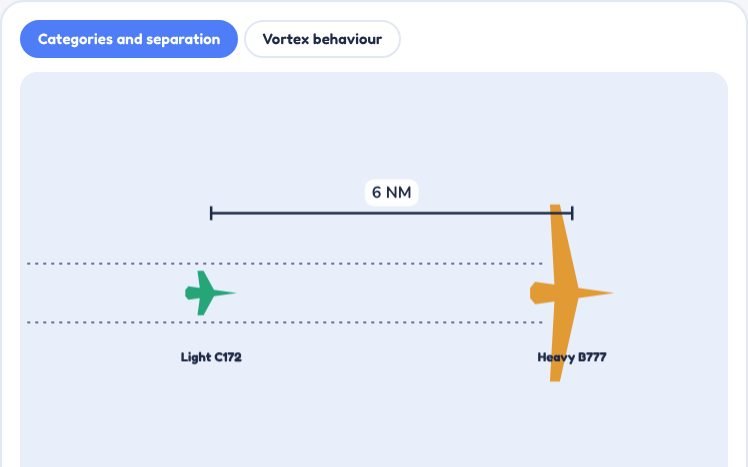
- Pick a leader and a follower and see the minimum radar distance or time that applies.
- Switch between radar, landing and take-off. Time-based minima are used when there is no radar.
- Open Vortex behaviour and play the clock. Watch the two vortices sink, hit the ground and spread.
- Add a light crosswind and see how one vortex can stay on the runway. Drag the small aircraft to test where you would be hit.
Exam point
Wake turbulence is worst behind a heavy, clean and slow aircraft. Vortices sink about 300 to 500 fpm, stay below the leader's path, and spread out near the ground. Stay at or above the leader's flight path.
Study aid only. Figures here are simplified and fictional, so always use current DGCA and ICAO documents and the approved manual for real operations.