737 Hydraulic System
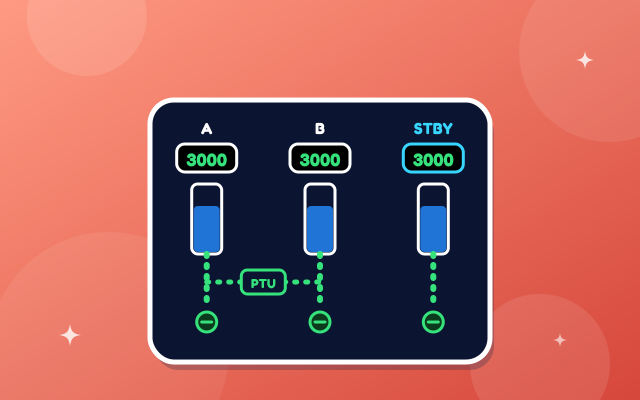
Systems A and B plus the standby system, the PTU and the standby pump. Fail a pump or lose a system and see what each user keeps.
Click an engine, a pump or the standby switch. Values are simplified.
Scenarios
What still works
Test yourself
737 Hydraulic System is part of lifetime access
Log in if you already have lifetime access, or unlock all 63 simulators, the full question bank and every flashcard for ₹3,499.
Or try the free ones: Wind Triangle and Altimeter.
Your account is on the free plan. Unlock all 63 simulators, the full question bank and every flashcard for ₹3,499, once.
Practise the questions
Hydraulics11 questionsFlight controls14 questionsLanding gear and brakes12 questionsWhat to try
- Run the scenarios one by one and read the table: normal, reduced, standby or lost.
- Click the engines and pumps to switch them. Note that system A uses the engine 1 pump and electric pump 2, and B uses the engine 2 pump and electric pump 1.
- Press the standby switch to cycle OFF, AUTO and ON, and see what the standby system powers.
- Switch on Flaps 1 to 15 and fail engine 1 to see the PTU work for the leading edge devices.
Exam point
Three systems: A, B and standby, each at 3000 psi. Normal brakes are on B and alternate brakes on A. Standby backs up the rudder, the leading edge devices (extension) and the thrust reversers. The B reservoir has a standpipe that keeps fluid for the standby. The PTU uses B pressure for the leading edge devices if the engine 1 pump is low. Check the allocation in your FCOM.
Study aid only. This is original teaching material, not Airbus or Boeing documentation. Layouts, values and procedures are simplified and can differ by aircraft version and operator, so always check your FCOM, QRH and course notes.