Airline test prep
Practice for the computer-based aptitude tests that airlines use when they select pilots, including ADAPT and COMPASS style tasks. Eight timed practice modules with scores saved to your account.
Your practice profile
Play a module and your best score appears here. It is saved to your account.
The practice modules
Each one has three levels and ends with a score and a few tips. 8 modules, included in lifetime access.
 Lifetime
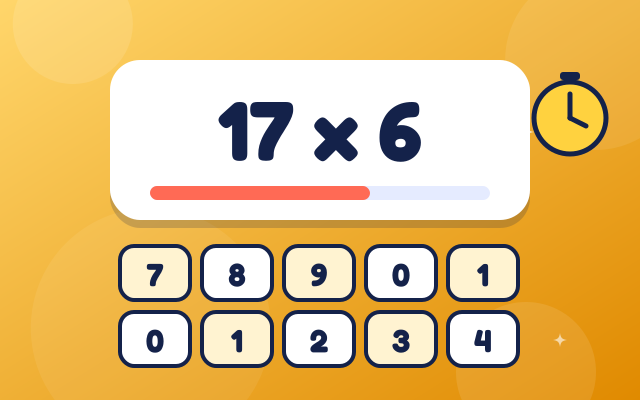
Speed Maths
Mental arithmetic against the clock, from plain sums to speed, distance, time and fuel, with no calculator.
 Lifetime
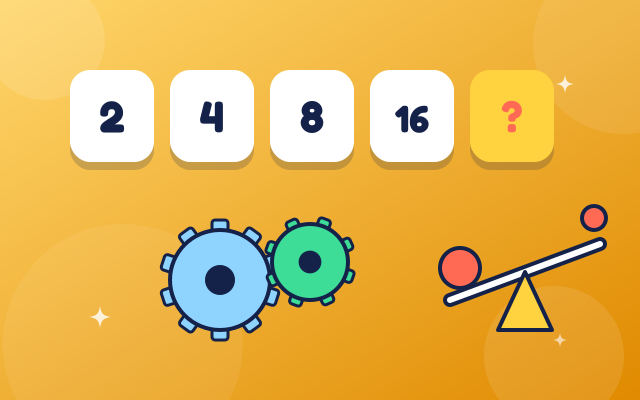
Number Series & Mechanics
Find the next number, then answer short physics and mechanical reasoning questions about gears, levers and pressure.
 Lifetime
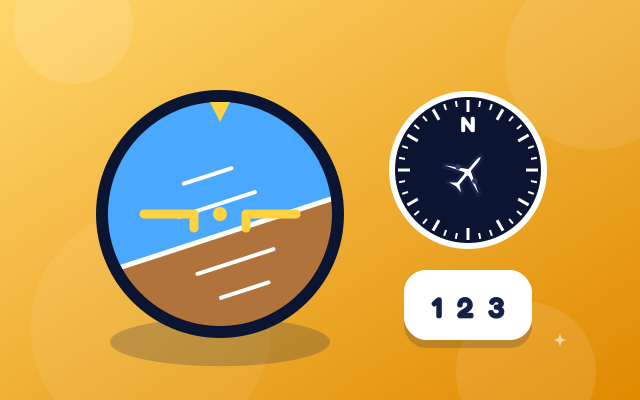
Instrument Comprehension
Read the attitude indicator and the heading, then pick the picture of the aircraft that matches.
 Lifetime
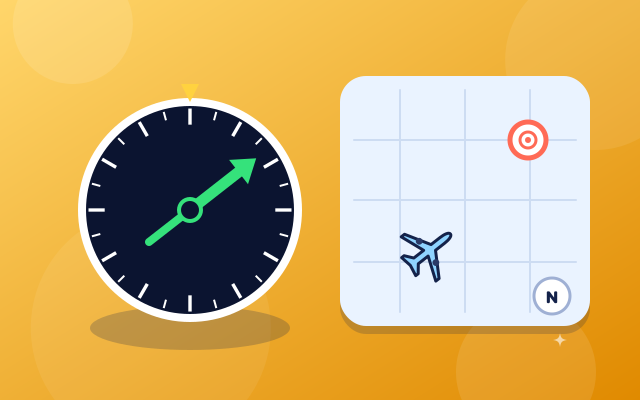
Spatial Orientation
Use the heading and the radio compass needle to find the map that shows where the station really is.
 Lifetime
Memory & Recall
Study a panel or a radio message for a few seconds, then answer from memory.
 Lifetime
Multitasking Flight
Fly around obstacles, count markers, answer sums and remember messages, all at the same time.
 Lifetime
Coordination Test
Keep the ball inside the ring with a virtual stick while it tries to drift away.
 Lifetime
Reaction & Rule Switch
Respond to shapes and colours, and adapt when the rule changes without warning.
What these tests usually measure
Candidates commonly describe tasks like these in airline pilot selection. The exact format depends on the airline and changes over time, so check what your airline tells you.
| Skill | Where to practise it here |
|---|---|
| Mental arithmetic and number series | Speed Maths, Number Series & Mechanics |
| Reading flight instruments and turning them into a picture | Instrument Comprehension, Spatial Orientation |
| Remembering numbers, panels and messages | Memory & Recall |
| Doing several tasks at once under time pressure | Multitasking Flight |
| Keeping a ball or marker on target (hand-eye coordination) | Coordination Test |
| Reacting fast and switching rules | Reaction & Rule Switch |
| Aviation knowledge: air law, navigation, meteorology, principles of flight | DGCA practice questions and mock tests |
How to use it
- Start each module on Easy to learn how the task works, then move up.
- Practise a little every day. Ten minutes of focus beats an hour once a week.
- Accuracy first, then speed. Wrong answers usually cost more than slow ones.
- Read the tips on the results screen. They point to your weakest part of that module.
- Before a real test, get a good night's sleep and read the airline's instructions carefully.
Good to know
- The tasks are original. Numbers, pictures and messages are generated fresh every time, so you cannot memorise them.
- Scores save to your account, and you can reset them on the Account page.
- This is study and practice material only. It does not guarantee selection by any airline.
Questions
Is this the real ADAPT or COMPASS test?
No. These are original practice tasks of the same kinds that candidates describe: mental arithmetic, number series, reading instruments, spatial orientation, memory, multitasking and hand-eye coordination. They are not copies of any test, they are not made by or connected to the companies that publish those tests, and no airline has approved them.
Will practising here guarantee a pass?
No. Nobody can promise that. Practice makes the task types familiar, which helps you stay calm and work faster, but airlines choose their own tests, timings and pass marks.
Can I compare my score with the real test?
No. Your percentage here only shows your own progress from one session to the next. Real tests use their own scales, so a number here does not predict a number there.
Which airline uses which test?
It changes, and airlines do not always say. Check what your airline sends you. The practice here covers the skills that these tests commonly measure, so it is useful whichever test you are given.
The real coordination test uses a joystick. Is this the same?
No. Here you use an on-screen stick, the keyboard or a touch screen. It trains the idea (small, early corrections under drift) but not the feel of a real joystick.
What is not included?
The personality questionnaire and any spoken English or listening test are not included. For the aviation knowledge part (air law, navigation, meteorology and principles of flight) use the DGCA practice questions and mock tests, which are in the same lifetime access.
Is it included in the lifetime price?
Yes. The airline test practice is part of the same one-time payment as everything else on the site. It is not part of the free plan.